I hear so many people ranting about the oil spill in the Gulf. If you havent heard about it, you've been living under a rock, but I'll recap, anyway. If you aren't some hermit or didn't just wake up from a several month coma and do know what I'm talking about, feel free to skip the next paragraph.
In April, a BP deepwater drilling rig exploded, killing 11 and, despite several attempts to stop it, has been churning out more oil than has ever been seen before from an offshore oil spill in the US. As a result, there is obviously major damage to the gulf's ecosystem and the gulf coasts are all threatened. Further, no one knows when or how the flow will be finally stopped.
With the basics out of the way...everyone is naturally looking for someone to blame. Accusations against everyone from BP to the President are the norm. But, in all fairness, I don't think some giant political or corporate figure is who we ought to blame. Now, I'm not saying they didn't make mistakes, that they shouldn't have had more safety and precautionary measures in place, that there wasn't something obviously very faulty on the rig...I'm saying that, to borrow a wonderous line from a favorite movie, "How did this happen Who's to blame Well, certainly there are those more responsible than others...but again, truth be told, if you're looking for the guilty, you need only look into a mirror."
Why Look at how much of our country is dependent on oil. From everything from gasoline and everthing transported by things that burn it to the oil that coats our factory machinery to the rubber used on billions of products to all of the things created with or out of oil byproducts, we are a country that consumes over a quarter of the world's oil produced each year. BP doesn't consume all of that oil, the Obama administration doesn't consume all of that oil--WE DO, the masses of everyday citizens, as a collective whole. And it is that consumption which drives the oil giants to drill.
People rant about the Republican slogan of "Drill, baby, drill" and the party's push for offshore drilling, looking to place blame there, as well. Were offshore rigs rushed into production, compromising precautional proceedures Possibly. Is that the fault of the campaigns and the oil companies Partially...but the question remains as to why they did what they did. Look at the social, economical, and political reasonings behind that slogan. The US unemployment rates were at an alltime high, costs of everything were skyrocketing, and the American people were desperately looking for anything that might bring more jobs, more domestic profit, and lower the increase rate of inflation. The prospect of more domestic drilling fit the bill, and we jumped on it. Yes, we now look at it and say "that was a terrible thing", and yes, there were many opposed to it at the time, but there were and are a lack of other viable and easily implimented alternatives, and alternatives as a rule involve change, and people dislike change...so most did not oppose it. Hindsight is 20/20 and complacency and apathy rule.
Do I have a point, major opinion about what should be done, or solution to all of this Only that the next time you watch the news and see all of the oil floating on the water, the contaminated beaches, and the dying wildlife, and get angry, by all means, be angry--but think for a moment about who you should really be angry at, and recognize we all have a share in the blame.
Sunday, June 27, 2010

Thursday, April 22, 2010
Post via my phone
I just realized I never really take advantage of the fact I do have my blog set up to post from text messages...so this is a test of that.
Oh, as per the norm, I fail at updating. But, now perhaps, I will at least post little snippets from the phone, since I never seem to have the time to when I'm actually sitting at the computer.
Oh, as per the norm, I fail at updating. But, now perhaps, I will at least post little snippets from the phone, since I never seem to have the time to when I'm actually sitting at the computer.
Tuesday, March 9, 2010
I Fail at Updating
I should probably just accept that I miserably fail at blogging, given it's been not quite a year since I last updated this. However, this time I promise to try to at least semi-regularly post...something. No promises or guarantees about the content, as always.
That said...Happy New Year, about 3 months late! And enter the title of this post.
As usual, I've been incredibly busy and my to-do lists never seem to shrink. After having spent the last few (read: several) months running around like a chicken with my head cut off, I'm trying to settle into some semblance of a routine again.
In other news, earthquakes galore: Haiti, Chile, Turkey...the list seems to go on of 6+ magnitude earthquakes on the news lately. The worst, of course, is the utter destruction of the already incredibly impoverished Haiti. However, the I keep questioning, seeing all of the news reports, is if Chile will get the scope of aid it really needs, coming in the wake of the Haiti earthquake and the mass fundraising and aid sent there, and if the aid sent to Haiti will have the staying power, or if most of it will disappear as the world's focus shifts away and the bulk of the troops sent pull out. The cynic in me also wonders how much of the millions and millions of dollars and tons of supplies collected for people in Haiti will ever actually reach the people who need it the most. It's incredibly frustrating to know, too, that a healthy percentage of the aid will come at the cost of the native peoples' cultural norms and traditions. I have no solutions to offer, though, and recognize that aid, in any form, is probably usually better than none. For the majority and general masses, questions of religion or traditions mean very little when it's a matter of eating and having water to drink or not. Regardless, it's still sad.
And now, for something completely different
Yes, I am all over the place in this post, and yes, I should probably break it into a few posts. I don't feel like it, so I'm not. What I do feel like, though, is sharing a fun picture. You probably don't really want to know what it is, but it looks pretty:

You really want to know what it is? It's a picture. Of blood. And luminol.
Well, actually more of blood residue where the blood's been "cleaned up" and so there are only trace amounts of it left. Also, it's not really just plain luminol, either--it's technically Bluestar luminol, which just means it's brighter than regular luminol. The little details aside though...it's pretty, in some kind of creepy, morbid way. And it's the blend of aesthetics and morbidity that makes it perfect to end this post of randomness with.
That said...Happy New Year, about 3 months late! And enter the title of this post.
As usual, I've been incredibly busy and my to-do lists never seem to shrink. After having spent the last few (read: several) months running around like a chicken with my head cut off, I'm trying to settle into some semblance of a routine again.
In other news, earthquakes galore: Haiti, Chile, Turkey...the list seems to go on of 6+ magnitude earthquakes on the news lately. The worst, of course, is the utter destruction of the already incredibly impoverished Haiti. However, the I keep questioning, seeing all of the news reports, is if Chile will get the scope of aid it really needs, coming in the wake of the Haiti earthquake and the mass fundraising and aid sent there, and if the aid sent to Haiti will have the staying power, or if most of it will disappear as the world's focus shifts away and the bulk of the troops sent pull out. The cynic in me also wonders how much of the millions and millions of dollars and tons of supplies collected for people in Haiti will ever actually reach the people who need it the most. It's incredibly frustrating to know, too, that a healthy percentage of the aid will come at the cost of the native peoples' cultural norms and traditions. I have no solutions to offer, though, and recognize that aid, in any form, is probably usually better than none. For the majority and general masses, questions of religion or traditions mean very little when it's a matter of eating and having water to drink or not. Regardless, it's still sad.
And now, for something completely different
Yes, I am all over the place in this post, and yes, I should probably break it into a few posts. I don't feel like it, so I'm not. What I do feel like, though, is sharing a fun picture. You probably don't really want to know what it is, but it looks pretty:
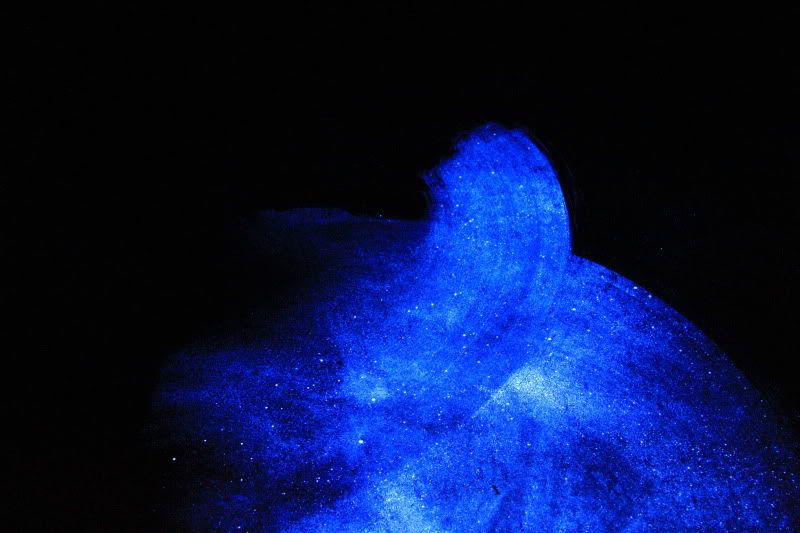
You really want to know what it is? It's a picture. Of blood. And luminol.
Well, actually more of blood residue where the blood's been "cleaned up" and so there are only trace amounts of it left. Also, it's not really just plain luminol, either--it's technically Bluestar luminol, which just means it's brighter than regular luminol. The little details aside though...it's pretty, in some kind of creepy, morbid way. And it's the blend of aesthetics and morbidity that makes it perfect to end this post of randomness with.
Sunday, April 12, 2009
Easter Randomness
There are times when a little brainlessness is good for everyone. I'm in a particularly odd mood tonight and randomly started braiding paper. Yes, you read correctly...three strips of paper, folded into a braid. It actually turns out to be interesting.

By the way, the paper strips are this sort of confetti, which had been in an Easter basket.
Also, in light of Easter...Happy Zombie Jesus Day, everyone!
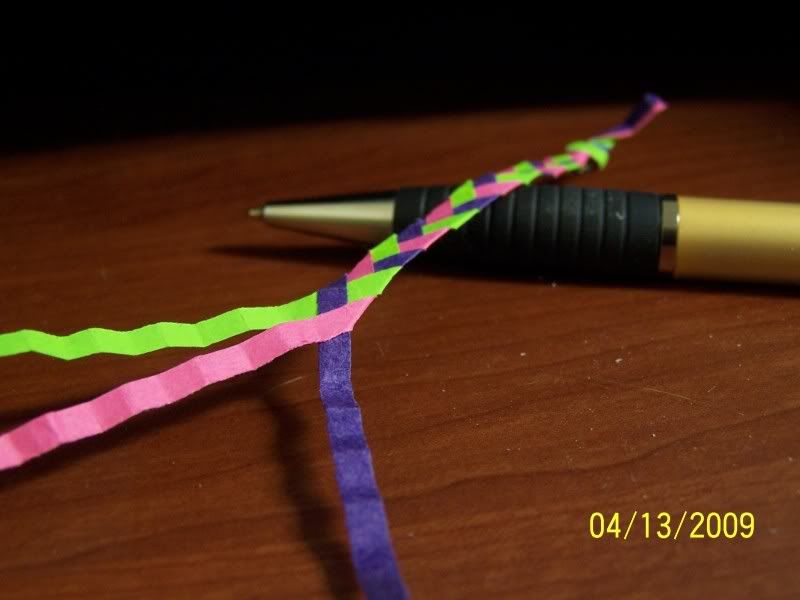
By the way, the paper strips are this sort of confetti, which had been in an Easter basket.
Also, in light of Easter...Happy Zombie Jesus Day, everyone!
Thursday, April 9, 2009
A Reason, A Season, or a Lifetime
A recent conversation and newly crossed path brought memories of this bit of wisdom I first read a long time ago, and which has stuck with me for years. Every now and then it pops up, but given it's one of the few things that always seems to strike a chord when it does, I think it deserves a place here among the musings and ramblings, and is certainly worth the read and some time spent pondering.
~Is______________
Author Anonymous
Many of us are fortunate enough to have friends who are a consistent part of our lives throughout all our ups and downs. However, sometimes others we consider friends appear to enter, then depart from our lives for reasons we try to, but don't always, understand. This piece nicely explains the flow of people in and out of our lives.
It is said that love is blind but friendship is clairvoyant.
People come into your life for a reason, a season or a lifetime. When you figure out which one it is, you will know what to do for each person.
When someone is in your life for a REASON, it is usually to meet a need you have expressed. They have come to assist you through a difficulty, to provide you with guidance and support, to aid you physically, emotionally, or spiritually. They may seem like a godsend, and they are! They are there for the reason you need them to be. Then, without any wrongdoing on your part, or at an inconvenient time, this person will say or do something to bring the relationship to an end. Sometimes they die. Sometimes they walk away. Sometimes they act up and force you to take a stand. What we must realize is that our need has been met, our desire fulfilled, their work is done. The prayer you sent up has been answered. And now it is time to move on.
Then people come into your life for a SEASON, because your turn has come to share, grow, or learn. They bring you an experience of peace, or make you laugh. They may teach you something you have never done. They usually give you an unbelievable amount of joy. Believe it! It is real! But, only for a season.
LIFETIME relationships teach you lifetime lessons: things you must build upon in order to have a solid emotional foundation. Your job is to accept the lesson, love the person, and put what you have learned to use in all other relationships and areas of your life.
Thursday, March 19, 2009
Unhabitual Creatures of Habit
As humans, we are creatures of habit. This has been well documented by any number of psychologists, sociologists, etc. However, what they often fail to study is how the people who live even the most unroutine lives still find ways to fit habit into them.
Anyone who knows me knows that I typically live one of the most irregular lives for forcing a routine into. What time I go to bed and get up (if I sleep at all); what, if, and when I eat; and where I go and how long I'll spend somewhere are all extremely flexible and fluid, and rarely stay the same for more than any 24-hour period.
However, I am still a creature of habit. For example, I can tell you /exactly/ how I dry off when I get out of the shower. That shower doesnt have to have been at the same time of day each day, doesnt even have to be the same type—be it in a bathtub or in a standing shower, etc. But no matter what, any time I am wet and drying off with a towel, I will always do it the exact same way—face, then arms (left to right), then legs (left to right), then back, then front, then hair. This never changes, and if I do try to alter it and dry in some other order, I don't actually feel dry, and typically will end up going back and drying in the normal way all over again.
There are hundreds of these little “habits” I can find throughout my day, no matter how random that day might be. The key question I have, though, is /why/.
Why do we feel the need to have routines and set up little habits, even when we may be the least routine-oriented person alive?
Some, I believe, has a good deal to do with how our minds work. We are wired to function on associations. Those associations can be extremely complex and deep rooted, like a woman distrusting a man instinctively because he has a similar scent to her abusive father, or they can be extremely simple, like associating the color of a shirt with a n apple because they're similar in shade.
Those associations are essential to our ability to grow, learn, and function within our daily lives and within society. It is because of those associations that we have the ability to speak, write, or read...someone at some point taught us that the letter “T” is associated with a specific sound when spoken, and that that in turn is also associated with any number of words, and the associated combinations mean different things. When we were babies, we learned that that feeling in our stomachs meant we were hungry, so we would cry and someone would come feed us, so we then associated that hunger with food and learned to eat when hungry. However, because we would cry, we also associated the crying with food, which made us feel better...thus a good part of the root reason there are so many people who are emotional eaters.
Every association eventually leads to a reaction, and the reactions eventually become habitual. These habits are essential for our ability to function efficiently within our lives. Can we change them? Certainly...but the greater question might be if we really need to or should change them. If we are fighting habits for the sake of fighting them, we are fooling ourselves, because there will always be habits, by our very natures. So, while we may not like to think of ourselves as creatures of habit, we will still tie our shoes the same way, we will still put the same leg in first when putting on our pants...and I will still dry off after getting out of the shower the exact same way, every time. Because, at the root, we are creatures of habit.
Anyone who knows me knows that I typically live one of the most irregular lives for forcing a routine into. What time I go to bed and get up (if I sleep at all); what, if, and when I eat; and where I go and how long I'll spend somewhere are all extremely flexible and fluid, and rarely stay the same for more than any 24-hour period.
However, I am still a creature of habit. For example, I can tell you /exactly/ how I dry off when I get out of the shower. That shower doesnt have to have been at the same time of day each day, doesnt even have to be the same type—be it in a bathtub or in a standing shower, etc. But no matter what, any time I am wet and drying off with a towel, I will always do it the exact same way—face, then arms (left to right), then legs (left to right), then back, then front, then hair. This never changes, and if I do try to alter it and dry in some other order, I don't actually feel dry, and typically will end up going back and drying in the normal way all over again.
There are hundreds of these little “habits” I can find throughout my day, no matter how random that day might be. The key question I have, though, is /why/.
Why do we feel the need to have routines and set up little habits, even when we may be the least routine-oriented person alive?
Some, I believe, has a good deal to do with how our minds work. We are wired to function on associations. Those associations can be extremely complex and deep rooted, like a woman distrusting a man instinctively because he has a similar scent to her abusive father, or they can be extremely simple, like associating the color of a shirt with a n apple because they're similar in shade.
Those associations are essential to our ability to grow, learn, and function within our daily lives and within society. It is because of those associations that we have the ability to speak, write, or read...someone at some point taught us that the letter “T” is associated with a specific sound when spoken, and that that in turn is also associated with any number of words, and the associated combinations mean different things. When we were babies, we learned that that feeling in our stomachs meant we were hungry, so we would cry and someone would come feed us, so we then associated that hunger with food and learned to eat when hungry. However, because we would cry, we also associated the crying with food, which made us feel better...thus a good part of the root reason there are so many people who are emotional eaters.
Every association eventually leads to a reaction, and the reactions eventually become habitual. These habits are essential for our ability to function efficiently within our lives. Can we change them? Certainly...but the greater question might be if we really need to or should change them. If we are fighting habits for the sake of fighting them, we are fooling ourselves, because there will always be habits, by our very natures. So, while we may not like to think of ourselves as creatures of habit, we will still tie our shoes the same way, we will still put the same leg in first when putting on our pants...and I will still dry off after getting out of the shower the exact same way, every time. Because, at the root, we are creatures of habit.
Saturday, December 20, 2008
The Origins of Christmas
First, Merry Christmas to all who celebrate it, and happy holidays to those of other beliefs.
Sometimes it seems that everyone celebrates Christmas as either a commercialized holiday for giving and recieving gifts or as a Christian holiday with the belief that it was the day that Jesus was born, but they generally aren't really aware of how December the 25th came to be called Christmas and why we have so many of the traditions that we do. Many of the reasons might surprise you...
First, it is very unlikely that Jesus was actually born in December. Biblical scholars believe that he was most likely born sometime in September--about six months after Passover.
Pope Julius the First declared in AD 350 that Christmas was to be celebrated on Dec. 25th. For some time before, Christmas had been celebrated on Jan. 6th.
There were several reasons for the choice of Dec. 25th. The feast of the Son of Isis (Horus) was celebrated on December 25 in ancient Babylon. Several traditions from this celebration have survived, most noteably the mass amounts of food and the practice of gift-giving. Also, Dec. 25th was the Winter Solstice on the Julian calendar, and was celebrated in Rome as the most important day in the celebration of Saturnalia. But probably the main choice for the date was because the largest pagan religion of the time, the sun-worship religion (usually refered to as a cult) of Mithraism also celebrated their most important holiday on the 25th of December, which was called 'the Nativity of the SUN". The date was also considered the birthday of Sol Invictus, the Invincible Sun-deity, in another popular pagan religion. The growing Christian church wanted their followers to be able to take part in all of the existing festivities and being able to still partake in such celebrations was a strong point in convincing people to convert to Christianity.
There are also countless other blended traditions in Christmas besides the choice of day. The popularity of mistletoe and holly stems from the Celtic culture of the British Isles where they were among the most revered all green plants as important symbols of fertility. They were often used in decorations of alters and around homes.
The tradition of Christmas carols comes from the Roman tradition of Mummers--a group of costumed singers and dancers who went from house to house, singing and performing.
The burning of the Yule Log, a tradition that has started to fade in the more recent decades, comes from the pagan worship of vegetation and fire, and is associated with magical and spiritual powers. Also, the most common translation of the word Yule is “wheel”, the wheel being a pagan symbol for the sun.
The idea of the Christmas Tree evolved from the Druid practice of using the tree as a religious symbol, which evolved into bringing evergreens into homes as winter-time decorations and symbols of eternal life.
When you go to turn on the CD of Christmas carols, open packages, or look at your Christmas tree, think about where the traditions have come from and maybe understand a little more about why We do the things that We do and remember that most of the things in this "Christian" holiday really aren't Christian in origin at all.
Sometimes it seems that everyone celebrates Christmas as either a commercialized holiday for giving and recieving gifts or as a Christian holiday with the belief that it was the day that Jesus was born, but they generally aren't really aware of how December the 25th came to be called Christmas and why we have so many of the traditions that we do. Many of the reasons might surprise you...
First, it is very unlikely that Jesus was actually born in December. Biblical scholars believe that he was most likely born sometime in September--about six months after Passover.
Pope Julius the First declared in AD 350 that Christmas was to be celebrated on Dec. 25th. For some time before, Christmas had been celebrated on Jan. 6th.
There were several reasons for the choice of Dec. 25th. The feast of the Son of Isis (Horus) was celebrated on December 25 in ancient Babylon. Several traditions from this celebration have survived, most noteably the mass amounts of food and the practice of gift-giving. Also, Dec. 25th was the Winter Solstice on the Julian calendar, and was celebrated in Rome as the most important day in the celebration of Saturnalia. But probably the main choice for the date was because the largest pagan religion of the time, the sun-worship religion (usually refered to as a cult) of Mithraism also celebrated their most important holiday on the 25th of December, which was called 'the Nativity of the SUN". The date was also considered the birthday of Sol Invictus, the Invincible Sun-deity, in another popular pagan religion. The growing Christian church wanted their followers to be able to take part in all of the existing festivities and being able to still partake in such celebrations was a strong point in convincing people to convert to Christianity.
There are also countless other blended traditions in Christmas besides the choice of day. The popularity of mistletoe and holly stems from the Celtic culture of the British Isles where they were among the most revered all green plants as important symbols of fertility. They were often used in decorations of alters and around homes.
The tradition of Christmas carols comes from the Roman tradition of Mummers--a group of costumed singers and dancers who went from house to house, singing and performing.
The burning of the Yule Log, a tradition that has started to fade in the more recent decades, comes from the pagan worship of vegetation and fire, and is associated with magical and spiritual powers. Also, the most common translation of the word Yule is “wheel”, the wheel being a pagan symbol for the sun.
The idea of the Christmas Tree evolved from the Druid practice of using the tree as a religious symbol, which evolved into bringing evergreens into homes as winter-time decorations and symbols of eternal life.
When you go to turn on the CD of Christmas carols, open packages, or look at your Christmas tree, think about where the traditions have come from and maybe understand a little more about why We do the things that We do and remember that most of the things in this "Christian" holiday really aren't Christian in origin at all.
Subscribe to:
Posts (Atom)

